


Red date drying in drying process
Release time:


Red dates are a fruit tree variety unique to my country, with a cultivation history of more than 4,000 years. 90% of the world's red date production comes from my country.
The main varieties of red dates are: gray dates, Jun dates, golden dates, winter dates... Generally, there are 5 to 6 grades between the same varieties, which determine the price. The concentrated areas of red date production and processing in China: Cangzhou, Hebei, Zhengzhou, Henan, Leling, Shandong, Shanxi, Guangzhou, Guangdong, Hunan and most areas of Xinjiang. Due to the constant changes in climate and soil conditions, many of the areas mentioned above are no longer suitable for the growth of red dates. However, due to historical development, these places that once produced high-quality red dates have become large distribution centers for Chinese red dates, in addition to having a negligible output, and more importantly, the red dates are now from Xinjiang.
Xinjiang is now the most suitable region and area for growing red dates in the country, and even in the world. Because Xinjiang's unique advantages and conditions are incomparable to those in the mainland and other regions. Because Xinjiang is a topographic feature of "three mountains and two basins", the edge of the basin is Gobi, the middle of the basin is desert, far away from the ocean, and blocked by high mountains. This has formed the inland arid climate characteristics of Xinjiang's temperate and warm temperate zones: first, the temperature difference between spring and autumn is large, second, the precipitation is small, third, the sunshine is very sufficient, fourth, the climate is dry, and fifth, the land resources are rich. These advantages have formed the unique quality of Xinjiang red dates. Xinjiang red dates are higher in sugar content, soluble solids, VC, and other qualities than the same varieties in the mainland, and the taste is better than the same varieties in the mainland. The quality of mainland red dates cannot be compared with Xinjiang red dates.
Red dates are a traditional health food for Chinese people and are rich in nutrients. In addition to some fresh food, most red dates are directly eaten as non-washed dried fruit products in the consumer terminal market; in addition, the red date production area is relatively concentrated, and the harvest is concentrated in the autumn harvest period while the consumer market is facing the whole country. In order to facilitate storage, transportation and sales, red dates need to be washed, dried, cooled and softened, sterilized and packaged.
Red dates are rich in dietary fiber and sugar. Different natural climate, water and soil, sunshine conditions, the growth cycle of the date tree itself, and nutrient acquisition jointly determine the quality of red dates. The standards for identifying the quality of red dates mainly refer to its fruit shape, taste and color. High-quality red dates are rich in dietary fiber and sugar, with a full and elastic shape, sweet taste and bright red color.
There are two methods for processing red dates: natural drying and artificial drying:
Natural drying: Due to the long time and many uncertain factors, a lot of manual turning is required, and the color of the dried finished product is also uneven, which is not suitable for large-scale operation.
Artificial drying: There are many methods, and the more traditional one is to use coal combustion to generate heat for drying. In the past two years, air pollution has been more serious, and the environmental protection department has strengthened supervision. Many places are banning coal-fired boilers. At the same time, a large amount of sulfide will be produced during coal combustion, and secondary pollution will also be generated during food processing. In the future, coal drying is no longer the best choice. The following mainly introduces the application of dryers in drying red dates.
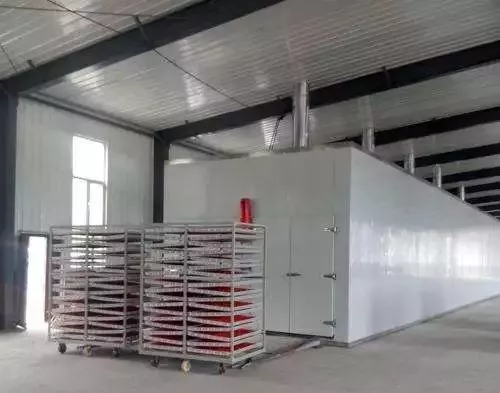
The core of red date processing is drying. Drying red dates is the process of evaporating internal water and converting sugars while preserving the original quality of red dates as much as possible, which is the process of ripening. Red dates contain rich sugars, and the polysaccharides contained in them are a substance without sweetness. They must be converted into monosaccharides under the action of biological enzymes before they can become sweet. This is why red dates ripen and become sweet. We need to make the sugars inside the red dates fully converted under the action of biological enzymes, so we need to enhance the activity of biological enzymes. Through long-term practice, we have found the best temperature range for the conversion of sugars inside red dates: around 60 degrees.
1. Heating stage
During the drying process, if the jujube fruit directly enters a high temperature environment suitable for sugar conversion, the huge temperature difference will cause the red jujube to undergo a biological protection reaction, the epidermal cell pores will shrink, the crust will harden, and the evaporation of water inside the red jujube will be prevented. Therefore, it is necessary to fully preheat the red jujube in the early stage of drying, and gradually increase the temperature to prepare for the evaporation of a large amount of water. Keep it at 45℃ for 2 to 3 hours. When the temperature of the jujube reaches 45℃, it will feel slightly hot. After 2 to 3 hours, wrinkles will appear on the jujube body when you press it hard; when the temperature of the jujube reaches 45 to 48℃, a layer of small water droplets will appear on the surface of the jujube.
2. Drying stage
Make the free water inside the jujube evaporate in large quantities. At this time, the temperature must be increased to 65℃ in the drying room within 3 to 5 hours, and it is forbidden to exceed 70℃. In order to facilitate the evaporation of a large amount of water, pay attention to dehumidification, and keep the indoor temperature from changing greatly, so as to continuously evaporate water. When wrinkles appear on the surface of the jujube, it means that the drying is normal.
3. Dehumidification stage
When the temperature inside the jujube is uniform, this stage of work can be completed within 6 hours. Because there is not much moisture in the jujube in the later stage, special attention should be paid to temperature control, and it should not be too high. 50℃ is the best. At this time, the relative humidity has also dropped. If it is higher than 60%, it can be slightly dehumidified. As the moisture in the jujube gradually balances, the purpose of drying is achieved. Pay attention to unloading the dried samples in time.
4. Cooling
The baked jujubes must be ventilated and heat-dissipated, and they can be piled up after cooling. If the red dates just unloaded from the drying room are piled in the warehouse, because the red dates themselves contain a lot of sugar, under the action of heat, the sugar is easy to ferment and deteriorate, and the original pectin in the dates will also decompose into pectin and pectin acid, which will inevitably make the dates a pile of mud, and will also change the sugar in the dates, and appear with sour filaments, so that the red dates are damaged. Therefore, after baking, it must be thoroughly cooled before storage.
Nowadays, drying equipment has solved the quality and efficiency of red dates drying, aiming to reduce more energy consumption and save more costs.

(Note: The drying process of red dates of different varieties, sizes, regions and moisture contents will be slightly different. The above summary is for the process of gray dates)
Previous
Next
Previous
Next

E-mail: 18150135290@163.com
Phone: +86-18150135290
WhatsApp: 8618150135290