


Science | The benefits of drying with an air-to-air heat pump
Release time:

Drying, as an ancient process unit, has been widely used in all areas of social production and life. At the same time, however, drying consumes a great deal of energy in the production of society. Data shows that the drying process uses at least 15% of the world's energy. Even in the UK, drying accounts for 13-15% of national energy consumption. In the field of wood production, drying reaches 70% of energy consumption, while in the textile industry and in grain processing, drying reaches 50% and 60% of energy consumption respectively. Therefore, efforts have been made to improve the energy use efficiency of drying.

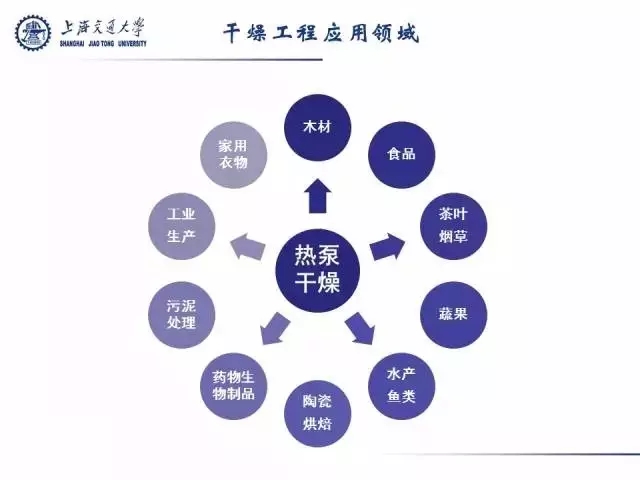
In addition, the demands on product quality and productivity have led to the development of drying systems that can improve the quality of the dried product and shorten the working cycle. The world's first patent on the application of heat pumps in drying was created relatively early. In China, the case of heat pump drying system also appeared relatively early, but its rise is in recent years. In recent years, heat pump drying systems with their high thermal efficiency and better drying quality have attracted the attention of the market and have been gradually used in recent years.
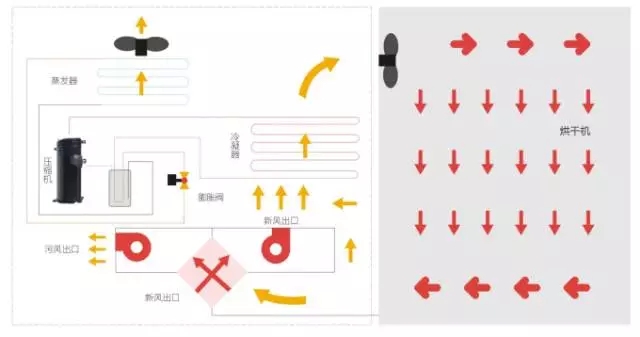
A basic typical heat pump drying system consists of a drying chamber, evaporator, condenser, compressor and throttle valve, respectively, as shown in the diagram. These components make up the drying medium (air) circuit and the heat pump mass circuit.
The heat pump as the core of the drying system in recent years gradually get more and more attention, the academic world about the heat pump drying system gradually increase the subject, the industry about it and the application of the transaction amount is also increasing. This is because it has its own advantages worthy of attention and application.
More efficient use of energy
As we know, heat pumps have a more efficient heating capacity than direct energy supply, as demonstrated by the fact that their heating to energy ratio (COP) is always higher than 1. Energy is always conserved and excess energy does not increase for no reason. However, in common heat pump applications, the energy other than the electrical energy supplied by the compressor comes mainly from external thermal energy absorbed by the evaporator, for example from the ambient air, i.e. air energy.
In a heat pump drying system, on the other hand, in addition to the electrical energy from the compressor, the thermal energy that the drying hot air has comes from the thermal energy contained in the drying exhaust gas that is absorbed by the evaporator. Because the heat energy of the drying exhaust gas is often high in temperature and contains a large amount of latent heat, it has a high calorific value and has a better heating effect and high efficiency of energy utilisation as a heat absorption source than the general heat pump air energy.
It is for this reason that whatever the type of heat pump drying system, it has the ability to recover the latent heat of the drying exhaust gas and at the same time the heat pump drying system will be able to achieve a higher energy use efficiency. Researchers have compared it with steam drying and found that it can still achieve energy savings of approximately 40%-70%.
Better drying quality
For example, drying defects such as deformation, cracking, surface hardening and colour darkening do not generally occur. This property has been widely recognised and proven by academia and industry. Researchers in Singapore, for example, have found that drying ginger using a heat pump drying system results in better flavour and retains more of the ginger pheromones than conventional hot air drying. Although the mechanism behind this phenomenon needs to be further investigated, it does not detract from the conclusion that heat pump drying technology can lead to higher drying quality. The reasons for this can be broadly explained by the fact that on the one hand the heat pump system provides a gentler drying environment and on the other hand the greater controllability and accompanying control system enables the most appropriate drying strategy to be adopted for the material.
Lower operating costs
As previously mentioned, heat pump drying systems offer significant daily energy savings compared to conventional drying technologies for the same drying temperature and volume of wet material. At the same time, with the continuous improvement of the technology level related to heat pump drying, the heat pump drying system can work more reliably and stably, and its daily maintenance costs will be reduced accordingly.
In addition to this feature of the heat pump drying system, the high degree of automation can also significantly reduce labour costs and work difficulties. The ability to operate continuously 24 hours a day also makes it suitable for mass production in factories, which further reduces the average production costs.
Environmentally friendly and zero pollution
Finally, as the heat pump drying system uses electrical energy as a direct energy source, there is no source of air pollution or water pollution generated in the system, which has the characteristic of being friendly to the environment. Especially under the increasing pressure on the domestic environment and the government's increasing management of environmental protection, production methods with environmental friendliness and zero pollution are favoured by more and more customers. The heat pump drying system not only does not pollute the surrounding environment, but its clean working environment and low noise pollution are also very popular with the people involved in the working area.
Previous
Previous

E-mail: 18150135290@163.com
Phone: +86-18150135290
WhatsApp: 8618150135290