


Tobacco leaf drying
Release time:

After the tobacco leaves are braided into the drying room, they mainly go through five processes: low-temperature humidity control and yellowing, stable temperature and moisture removal and ripening, ventilation and dehydration to dry the leaves, and temperature and humidity control to dry the tendons. Each process has different requirements for temperature and humidity. Therefore, carefully controlling the temperature and humidity at each stage is the key to ensuring the quality of tobacco baking.

Tobacco leaf processing steps:
1. Low temperature humidity adjustment: The central task of tobacco leaves in the low temperature humidity adjustment and yellowing stage is:
① Protein decomposition and conversion of about 25%;
② Chlorophyll degradation of more than 85%;
③ Starch decomposition and conversion of about 60%;
④ Water loss of 30-40%.
Around these four central tasks, actively promote the decomposition and transformation of a series of high-molecular compounds inside the tobacco leaves to form some original aroma substances; while actively promoting the yellowing of tobacco leaves, reasonably coordinate the moisture content of tobacco leaves to lay a good foundation for the appearance quality of tobacco leaves. In this stage, from the appearance of tobacco leaves to internal physiology and biochemistry, the most influential factor is the degradation of chlorophyll, so it is called the yellowing period. The specific measures are: use lower temperature and slightly higher humidity to heat the tobacco leaves, lose water, soften and turn yellow.
This stage generally takes 48 to 60 hours. Be careful not to enter the next stage in advance when the yellowing degree of tobacco leaves does not meet the requirements.
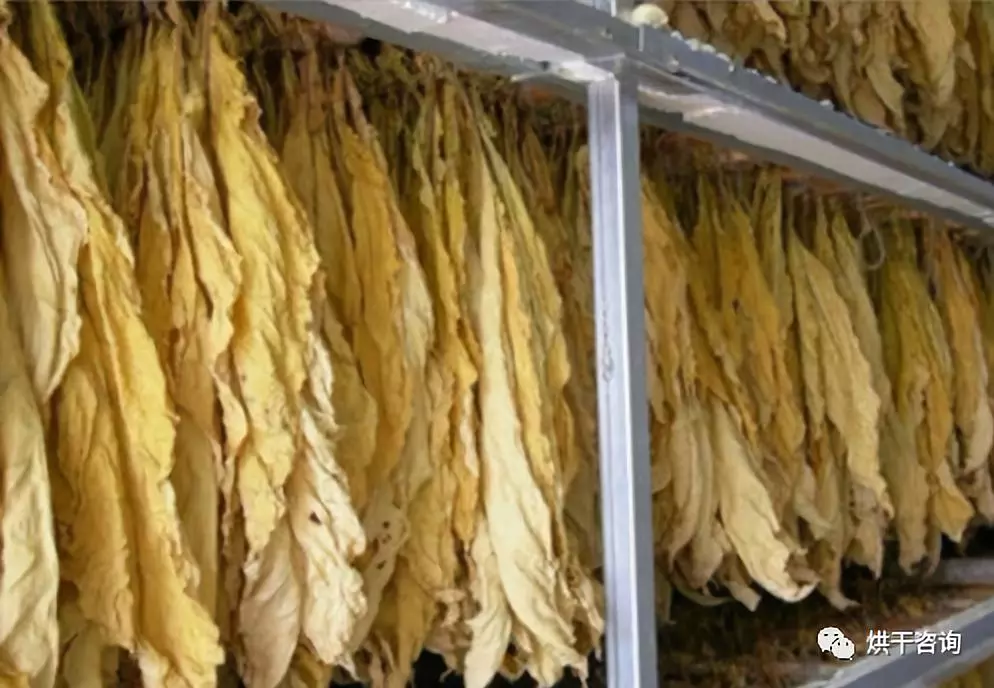
Second, after stabilizing temperature and removing moisture: The central task of tobacco leaf ripening is to maximize the decomposition and transformation of starch, total sugar, and protein to form more original aroma substances.
The specific measures are: stabilizing temperature, reducing humidity, and actively promoting the decomposition and transformation of a series of high molecular compounds in tobacco leaves while ensuring the stability of the yellow properties of tobacco leaves. The principle to be mastered is: stabilizing temperature and removing moisture, the temperature should not be too high, and the humidity should not be too high.
This stage generally takes 36 to 48 hours. Pay attention to the strict control of humidity. "No water, no yellowing, no water, no bad tobacco". Too much or too little water in tobacco leaves cannot achieve ideal quality.

Third, ventilation and dehydration of dry leaves: The central task of this stage is to compound and fix the small molecular substances represented by glucose and amino acids accumulated during the yellowing and maturity of tobacco leaves, and synthesize tobacco aroma substances.
The specific measures are: use higher temperature and lower humidity, fully open the exhaust window and air inlet tunnel, strengthen ventilation and dehumidification, remove the moisture of tobacco leaves, and fix the quality factors obtained during the yellowing and maturity periods of tobacco leaves.
This stage generally takes 24 to 36 hours. It is necessary to pay attention to the stability of temperature and rapid ventilation and dehydration.
Fourth, control temperature and humidity to dry tendons: At this stage, the main veins have been dried during the leaf drying period, and there is not much residual moisture, but the epidermis is thick, the tissue is tight, and the moisture evaporates slowly, but a large amount of ventilation and dehumidification is not required.
At this stage, it is necessary to pay attention to the temperature not being too high and the humidity not being too high to overcome the red tobacco.
Previous
Next
Previous
Next

E-mail: 18150135290@163.com
Phone: +86-18150135290
WhatsApp: 8618150135290