


The principle of air source heat pumps at a glance
Release time:

What is a heat pump
A heat pump is not a water pump, or even a pump, but a complete unit. The English name for a heat pump is HEAT PUMP and it has 2 definitions.
Definition 1: A circulating device that draws heat from a low temperature heat source to a high temperature heat source.
Definition 2: A device that compensates for the consumption of a portion of high-grade energy (mechanical, electrical or high-temperature heat) by transferring heat from a low-temperature to a high-temperature heat source.
Let us recall the physics.
The first law of thermodynamics: the law of conservation of energy.
The second law of thermodynamics: heat can be transferred spontaneously from an object of high temperature to an object of low temperature, but not from an object of low temperature to an object of high temperature.
So is the heat pump a monster that defies the laws of thermodynamics? Is a heat pump a perpetual motion machine?
Let's look at how heat pumps work.
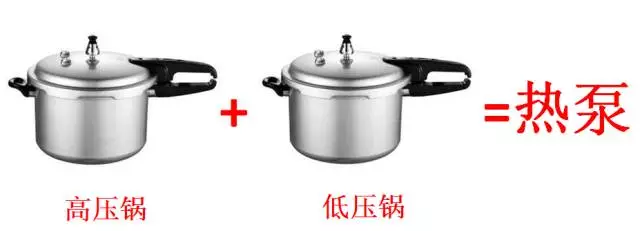
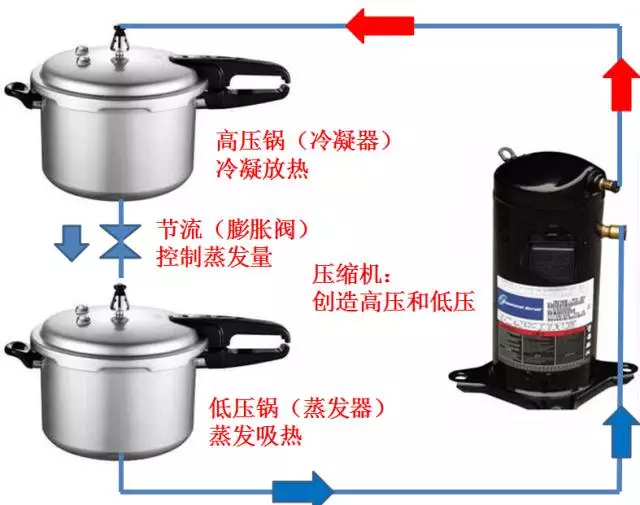
Pressure cooker: greater than 1 atmosphere, the boiling point of water will exceed 100 °C. In other words, under high pressure, water vapour will condense into a liquid at over 100 °C! At 2 atmospheres of pressure, the boiling point of water is 121 °C!
Low pressure cookers: at less than 1 atm, the boiling point of water will be below 100 °C. In other words, at low pressure, water will evaporate into gas at less than 100 °C! At 0.12 atmospheres, the boiling point of water is 50 °C!
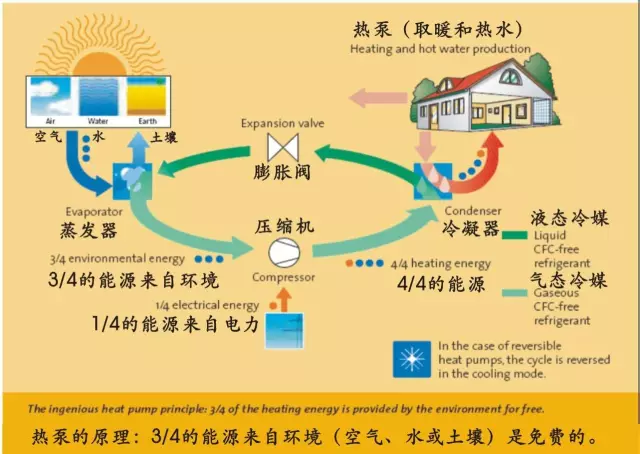
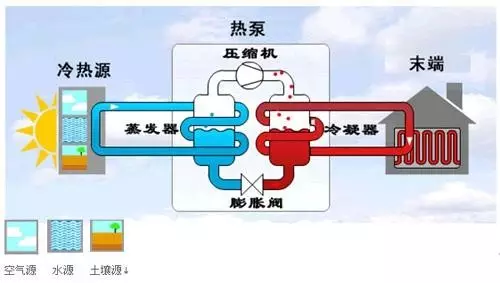
Through the compressor to do work, so that the work material to produce physical phase change (gas - liquid - gas), the use of this reciprocal cycle of phase change process constantly through the low-pressure pot (evaporator) heat absorption and high-pressure pot (condenser) exothermic, by the heat-absorbing device to absorb free heat, through the heat exchanger to make cold water warming, the hot water produced through the water circulation system to the user, so the heat pump does not violate the laws of thermodynamics.
The steam engine opened up the first industrial revolution and the world entered a new era of using energy on the principle of the Carnot cycle, a way of using heat energy to convert into mechanical energy, with an energy efficiency always below 1.
Heat pumps, on the other hand, ushered in a new era of energy conservation. The principle is the inverse Carnot cycle, a way of converting low temperature heat energy into high temperature heat energy using mechanical energy, and the energy efficiency is always greater than 1. The heat pump is the best way to save energy.
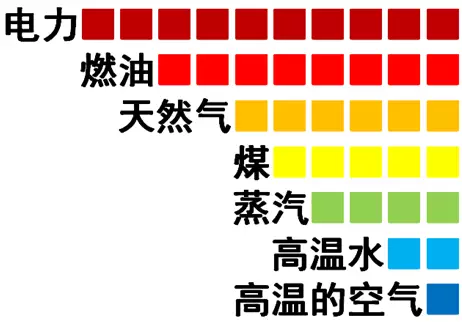
The highest density of the various forms of energy we know is electricity.
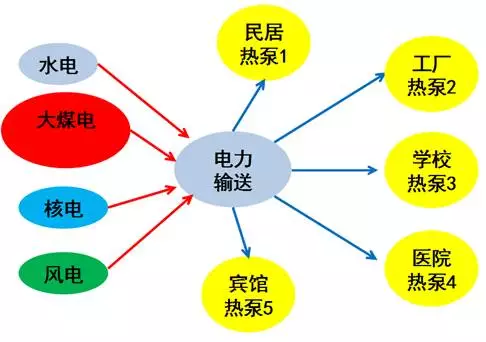
The best use of energy in China.
II Advantages of air source heat pumps
Air source has many advantages, the most basic is safe, efficient, pollution-free and convenient
Some experts say that to call the heat pump a renewable energy source, the average annual energy efficiency ratio of the heat pump should be greater than 2.7?
Let's argue whether this is right or not, currently 70% of China's electricity comes from coal, from this point of view, the experts are right, but the following two reasons for the application of heat pumps are highly recommended.
1, if the electricity comes from clean energy sources such as hydropower, wind power, solar wind power, etc., when the application of heat pumps is very environmentally friendly.
2, if the electricity used is surplus electricity from the grid, this electricity is not used, which is equivalent to waste, when the heat pump application of this part of the electricity, can play a very good role in peak shaving. In addition to the above-mentioned areas with long sunshine hours (e.g. Tibet, Yunnan), heat pumps are more advantageous than solar thermal in most areas of China, where heat pumps are the main protagonists, while there is no economy in investing in heat pumps and solar energy.
There are 2 sides to everything, and heat pumps are no exception, so what are the disadvantages of heat pumps?
The disadvantages of three air source heat pumps
1, low temperature performance decline
2, frost leads to a decline in performance
There are disadvantages not to be afraid of, there are always more ways than problems, then there are corresponding measures to deal with these 2 disadvantages.
Four how to overcome the shortcomings of air source heat pumps
In response to the decline in performance at low temperatures there are 5 points.
1, a larger heat exchange area.
2, frequency conversion technology.
3, two-stage compression technology.
4, Compounding compression technology.
5, Jet enthalpy technology.
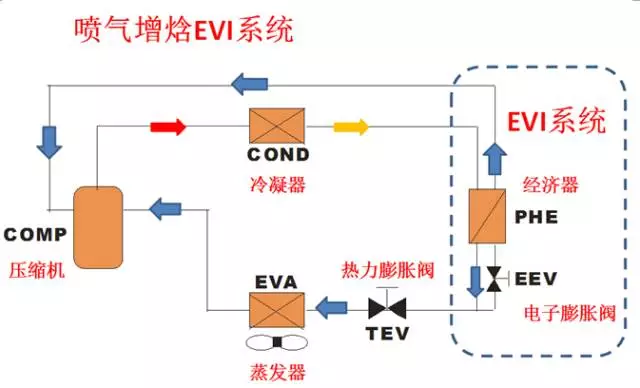
For the second problem - reduced frost performance - there are four solutions.
1, larger heat transfer area - retarding frost.
2, rational design of the finned heat exchanger - delaying frosting.
3, effective defrosting method model - shorten defrosting time.
4, accurate frost entry and exit points - reduce heat loss.
Five prospects for air source heat pumps
The application of air source heat pump is actually very wide, will develop to our life on all aspects, the application field can be summarized as 3 points: drying, heating and domestic hot water.


E-mail: 18150135290@163.com
Phone: +86-18150135290
WhatsApp: 8618150135290